
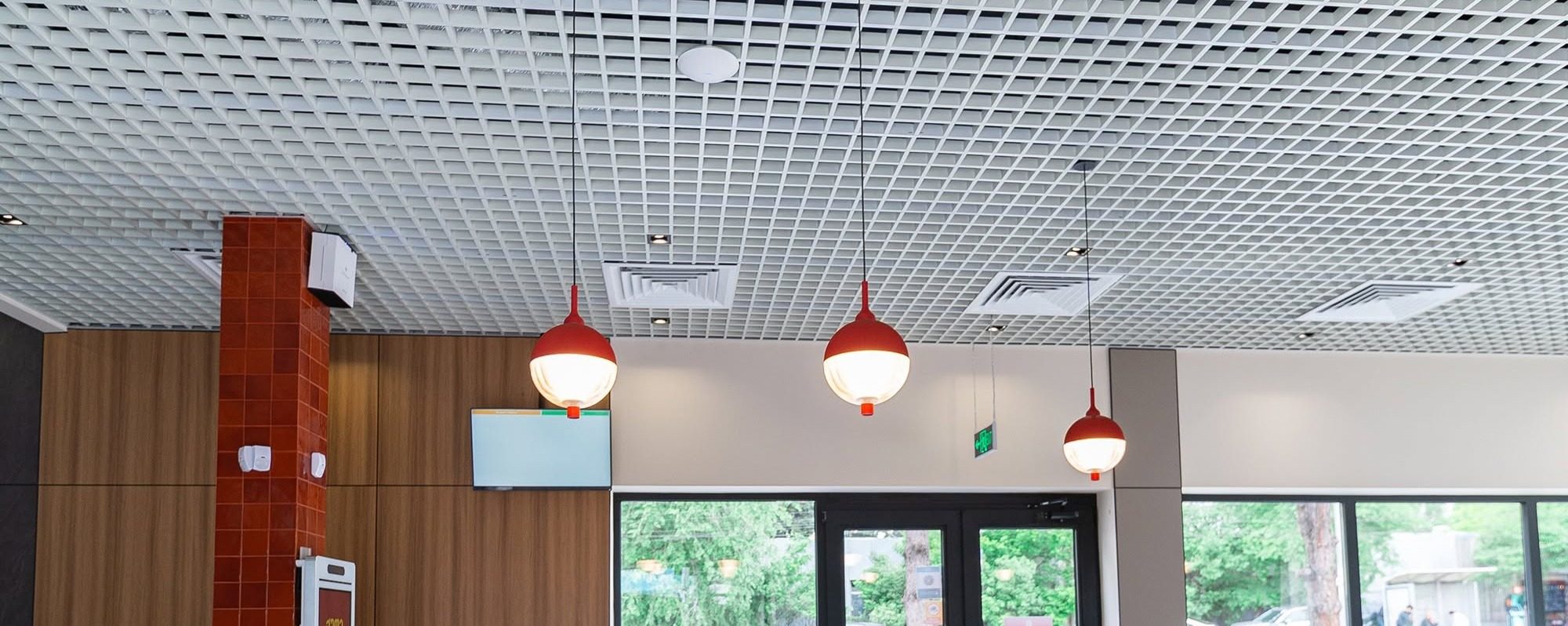
The most difficult thing when choosing a grid ceiling is choosing the cell size.
A grid model with a small cell means more coverage, but a significantly higher price, while a large cell model means a lower price, but high transparency and inefficiency.
The selection of the cell size is carried out depending on the projection of the object and depends on many factors. There is a scale established by standards, which takes into account the psychologically comfortable viewing area of a person, taking it into account, it is easy to obtain a rational and budgetary result. The opinion that in the case of high ceilings, it is more appropriate to choose a large cell is wrong. The view that in wide projection spaces, the use of a smaller cell than is permissible is also wrong, where part of the ceiling design is completely lost.
Therefore, when selecting a cell model, it is best to consult with a professional to get the optimal result at the optimal price.
Distinguishing the quality of Griliato ceilings before installation is not easy and requires observing many technical nuances. It is almost impossible to check the quality only with a sample without technical knowledge and measuring equipment. If you do not have the appropriate technical and engineering knowledge, it is better to request a portfolio of projects completed by the supplier, see the completed object yourself and only then make a decision. In an already installed assembled system, you will easily see the difference, which is impossible to notice on a single sample.
Calibration (accuracy of shape and cuts)
The most important factor when choosing a Griliato ceiling is the accuracy of the profile shape and cuts. International standards allow for +-0.20mm, but the higher the accuracy of the profiles, the easier the installation and the more effective the result.
In case of an error exceeding the permissible limit, you may not notice the error at first glance on the sample, but at the end of the installation you will definitely notice the incorrect geometry of the ceiling, uneven levels, gaps between the profiles, reflections of uneven profiles and, accordingly, a cracked ceiling. Access to the ceiling communications also becomes difficult, since incorrect geometry makes it difficult to remove and install the rafter cells. Incompatibility of profiles also complicates installation and increases costs, and in case of a high error, the system may not be physically assembled.
Griliato ceiling is a system ceiling and requires full compatibility of 5 different types of profiles with each other. If there is a difference of even a millimeter in the cut of any one type of profile, this means that in 20 meters this difference will add up to 60 mm, which will make it impossible to continue the ceiling assembly.
Material and coloring
A) In the case of a metal grid ceiling, the metal should be as light and strong as possible so that the weight of the ceiling does not exceed the minimum permissible safety weight and does not cause deformation over time due to excessive weight. The ideal metal thickness is 0.25 mm, while the permissible range is 0.20-0.30 mm. In the case of aluminum grid, this range is 0.30-0.45 mm.
B) Factory painting with metal polymer powder is a very important factor against corrosion. The ideal thickness of the coating is 20-25 microns, and the permissible norm is in the range of 15-30 microns. Thin coating may cause additional scratches during installation or operation, and over a long period of time, color change (tarnishing).
When selecting a grilyato material, it is necessary to consider the purpose of the installation space, the type of space it will be installed in, and the type of operating conditions it will be used in.
Metal grilyato have high performance properties, are much stronger than aluminum, are easy to install, and are not damaged during frequent installation and dismantling.
Due to the flexibility and elasticity of aluminum grilyato, frequent maintenance of the ceiling is not recommended.
Metal grilyato are more durable, long-lasting, and retain their original appearance for almost 10 times longer. Its only drawback is that in high-humidity areas (spa centers, saunas, etc.), where the humidity RH exceeds 65%, they are less resistant to corrosion than aluminum, and their service life may be reduced from 20 to 1 year.
Choosing the color of a Griliato ceiling is not difficult, but it is important to consider the effects of lighting and shadows. Improperly distributed lighting can radically change the perception of the actual color of the Griliato ceiling.
Grilyato ceilings are one of the most flexible ceilings in the modern construction industry, therefore almost all types of lighting can be attached to them.
The most important factor that you should not miss when designing lighting is that this is an open ceiling, its main function is to cover the ceiling communications, and therefore the interior space of the ceiling should not be illuminated. You should try your best to ensure that the light streams are directed from top to bottom, and not vice versa.
For commercial buildings, Griliato ceilings mainly use 3 types of luminaires:
A) Spot lights (installed in Griliato cells and selected according to the cell size)
B) Panel lights (585x585mm, with special mounting brackets)
C) Strip lights (any externally attached strip light)
A) When designing a suspended ceiling, it is important to consider that for the installation of a suspended ceiling, a minimum of 10 cm is required from the lowest point of the ceiling or any communications passing under it.
B) For installation of Grilyato ceilings, it is necessary that the ceiling installation level is closed in all parts of the perimeter (except for non-standard cases provided for by the design).
Information to be provided for accurate price calculation:
1. Area of installation space
2. Perimeter of installation space
3. Distance from existing ceiling level to installation ceiling level to determine the length of the mounting hangers.
Griliato ceiling planning and installation consultations are preferably performed at the site MEP system design stage, so that the ceiling communications and the ceiling are in technical harmony with each other from the very beginning.
Neglecting this may ultimately complicate the ceiling installation or necessitate a forced lowering of the ceiling level.
The installation of a Griliato ceiling is the final stage, when ceiling communications, wall painting, and other dusty repair work are completed.
Griliato ceilings do not dust naturally, but removing sticky construction plaster dust from small cells can be time-consuming during ceiling installation.